KUALA LUMPUR: As China and India expand their influence across the Global South, Southeast Asian countries should deepen their understanding of both powers to better navigate an increasingly competitive geopolitical landscape.
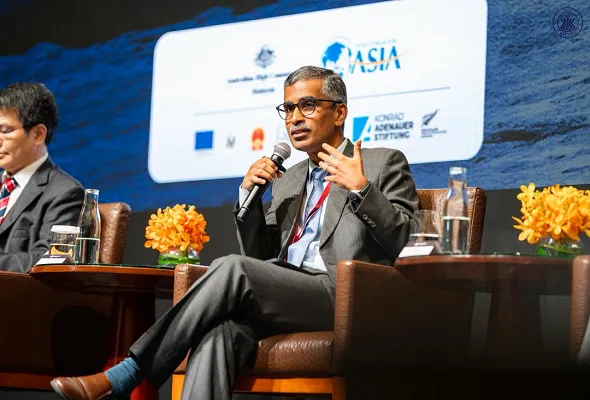
Associate Prof Dr. Jabin Jacob, Director of Centre of Excellence for Himalayan Studies at Shiv Nadar University, India said China currently holds an advantage in shaping its narrative across the Global South because it can back its ambitions with tangible economic capacity, including delivering infrastructure, green technology and development assistance at scale and relatively low cost.
India, he said, remains constrained by capacity but offers different strengths, particularly in governance, institution-building and human resource development.
To engage both countries effectively, Jacob said Southeast Asian governments should first define their own national interests and invest in expertise and institutions that deepen their understanding of both nations.
"Unless you develop your own capacities to understand India and China, you're not going to be able to make the most of it," he said on the sidelines of the 39th Asia-Pacific Roundtable,
Jacob also cautioned that ASEAN's long-standing approach of balancing major powers may become increasingly difficult as geopolitical competition intensifies.
"If ASEAN is not able to play the big players against each other, then the big players are going to play divide and rule," he said, citing the prolonged negotiations over the South China Sea as an example of the challenges facing the regional bloc.
While China remains Southeast Asia's largest trading partner, Jacob said the COVID-19 pandemic exposed the risks of excessive economic dependence on a single country, underscoring the need for regional economies to diversify their supply chains.
He also argued that high-level diplomatic engagements alone would not be enough to strengthen regional cooperation.
"High-level engagements such as BRICS are episodic, but they need to be backed up and built on a foundation of middle-level and lower-level engagements," he said.
Jacob said governments should invest more in academic exchanges, think tank collaboration, business partnerships and greater connectivity to build long-term trust and understanding across societies.
Looking ahead, he said India is unlikely to rival China's economic influence in Southeast Asia over the next five years, but it is expected to expand its security engagement in the region.
He pointed to growing defence cooperation with countries such as the Philippines and Vietnam and said India could eventually assume a larger role in regional maritime security, including around the Strait of Malacca, as strategic competition in the Indo-Pacific continues to evolve.


![[TB]_Takht-e Marmar UNESCO World Heritage site_REUTERS](https://resizer-vortals.eco.astro.com.my/tr:w-auto,h-auto,q-80,f-webp/https://media.astroawani.com/awani/media/uploads/image/2026-06/%5BTB%5D_Takht-e%20Marmar%20UNESCO%20World%20Heritage%20site_REUTERS.jpg?VersionId=Go3nPPh8RYSJLuMIh8V73ZIcXdP5oXm.)